- Jun 3, 2025
One Year Down: Child-led Home Education
- Courtney Ashworth
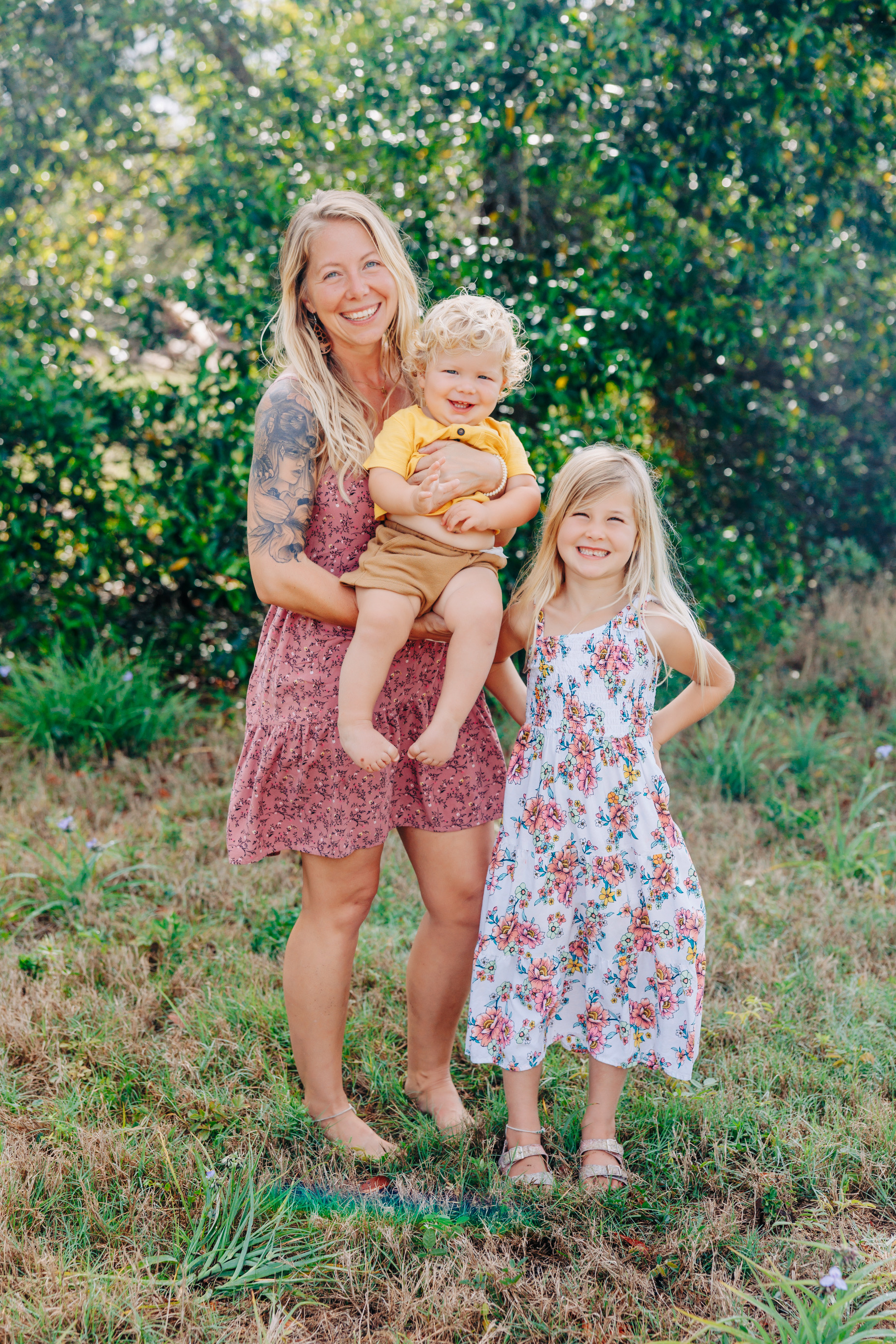
We did it! Ceanna has officially completed her kindergarten year of home education. I hesitate to call it the "first" year, because it feels more like a continuation of what we’ve been doing since birth—trusting her natural curiosity and growth.
I feel immense gratitude for the wisdom imparted on me while pregnant with Ceanna, for the beautiful connections I made in that season, and specifically my doula who planted a deep faith in me: my daughter is wise. Of course, dropping into this faith was intended to connect me to an internal softening and release into natural childbirth. Yet, it’s continued to shape how I parent on every level.
If you’d asked any earlier version of Courtney if she would be a free-range type of mom, she would have laughed. Younger Courtney’s were all controlling, through and through. She knew. She knew it all; she knew it best. She had to be in the command seat, and everything had to be just so. Lack of control felt like anxiety, racing heart, tight stomach, hot head. Being in control, I could pretend none of these were a part of my experience (they still very much were, but of course I got to tell myself the story that I had control over it!)
But the interesting thing is that becoming a mom has softened this way of being so much so … and what still surprises me 6 years later … it feels good. I thought for sure if I were to let go of control, that would cause anxiety. But to the contrary, trusting my daughter’s internal wisdom and self-guidance over her life feels like an exhale to me, we get to witness her in all her quirky beauty as she expands organically into the full expression of who she is here to be.
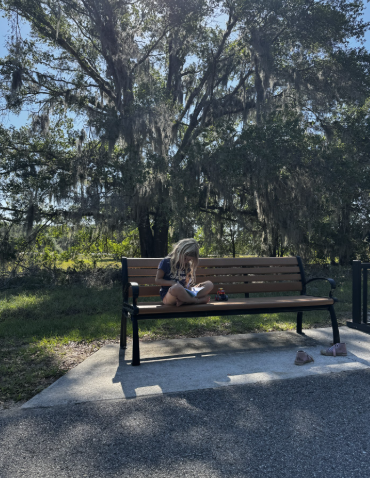
Trusting Ceanna to guide her learning in these early years of homeschooling has been peaceful and deeply fulfilling.
I didn’t need to dictate when or how Ceanna learned to walk or which words she’d say first – she had a natural inclination to learn from birth (just like all babies – we’re born curious and wired to learn). As Dr. Peter Gray puts it, “children are biologically designed to self-educate”. And I now believe wholeheartedly that this doesn’t have to change at age five, or any age for that matter, despite society telling us this is the age we ought to send our kids away for instruction.
As we began this homeschool year, our newborn son had just arrived months prior. Together, my husband and I tried to imagine how I’d manage both seasons—new baby and a kindergartener at home. We knew from our friends who had sent their children to school that in kindergarten kids are now expected to forge into reading. I’d need to review sight words and be prepared to teach her to count in the 100s. What would it look like to be sitting down with her and flashcards, while breastfeeding our son? Would we spend his nap windows diving into workbooks? Would I hand her screens with educational games to occupy her while I tended to him? While all of this seemed possible and maybe even reasonable, it didn’t feel right for us. It didn’t land in my body as the most wholesome approach that we wanted for either of our children, or for my own time.
Together we vowed to take the pressure off and lean into a slower, gentler rhythm. Gratefully, I’d been introduced to unschooling—a philosophy that values child-led learning. While I’m unsure it’s our forever approach, it offered a framework that allowed me to say: it’s okay to be “behind” if it means honoring our pace. And yes, as a recovering perfectionist, some days I worried we weren’t doing enough. But more often, I knew we were right on time.
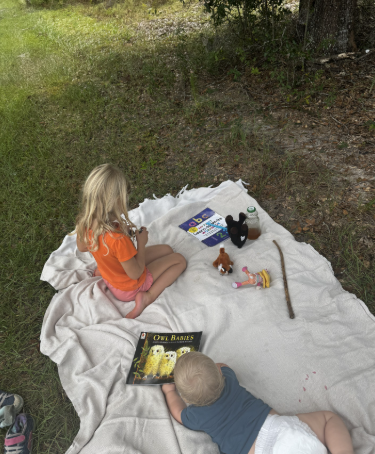
This year, Ceanna could have learned to read. Instead, she cuddled her baby brother, while I read aloud to them both.
She blossomed into her own sense of self and authenticity. She practiced patience, listening and communication. She cultivated life skills simply by being immersed in real life. She learned to communicate her ideas and what she wants or needs at a maturity level, beyond many adults I know. She deepened her creativity and imagination as she set up play schemes in our front yard. She surrendered to boredom and missing out, as there were days our family simply needed to stay home and rest (again, a skill I see many adults lacking, as we all treat boredom as the enemy in this country).
She developed leadership skills, something several of my mom friends have noted witnessing in her in how she interacts with her friend-groups. She developed deep empathy and compassion for people of all ages—connections she was able to nurture because she was home, rather than in school. She spent meaningful time with her baby brother, supported her postpartum mama, witnessed her dad make a major career shift, and her teenage brother navigate entering adulthood, sprinkled in time with grandparents, and even made friends with our 85-year-old neighbor, all while cultivating friendships with kids between the ages of 1-10.
She gained a real understanding of what’s involved in caring for a baby in his first year—learning how to change diapers, engage with him at different developmental stages, and adjust how she held him as he grew. A recent tear-jerking moment I’ll forever hold in my heart was watching Ceanna beam with pride, showing him off to her friends on that first playdate the week he learned to walk.
And oh how this reminds me, all of what Kenny would have missed out on had his big sister gone to school – not only does he get the best playmate, cheerleader, and tender love from his sister - this kid is regularly surrounded by joyful kids just a few years older than him, and their amazing moms – people we simply wouldn’t be spending as much time with if our kids were all in school.
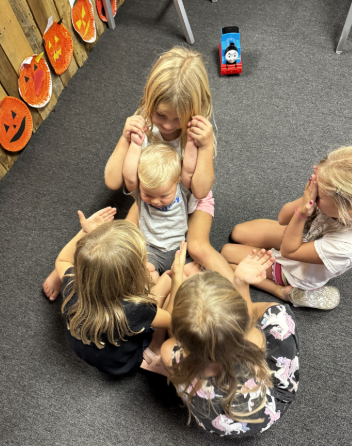
So, grandparents, you may be asking, what did our home education practically look like? Our days included play, baking, nature walks, conversations, picture books, puzzles, dancing, boredom, and spontaneous learning.
We followed guidance from the likes of experts like Dr. Victoria Dunckley who summarized what children need to develop optimally in her book, Reset Your Child’s Brain, like this: “kids need several hours of unstructured physical play daily to adequately stimulate and integrate sensory pathways, they need secure attachment to caregivers, plenty of touch, and carrying levels of environmental stimulation that support calm alertness during the day and restful sleep at night. They also need conversation with adults, contact with nature, and creative outlets, such as music, art, or dance.”
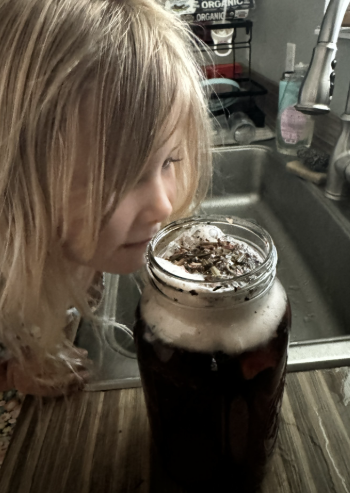
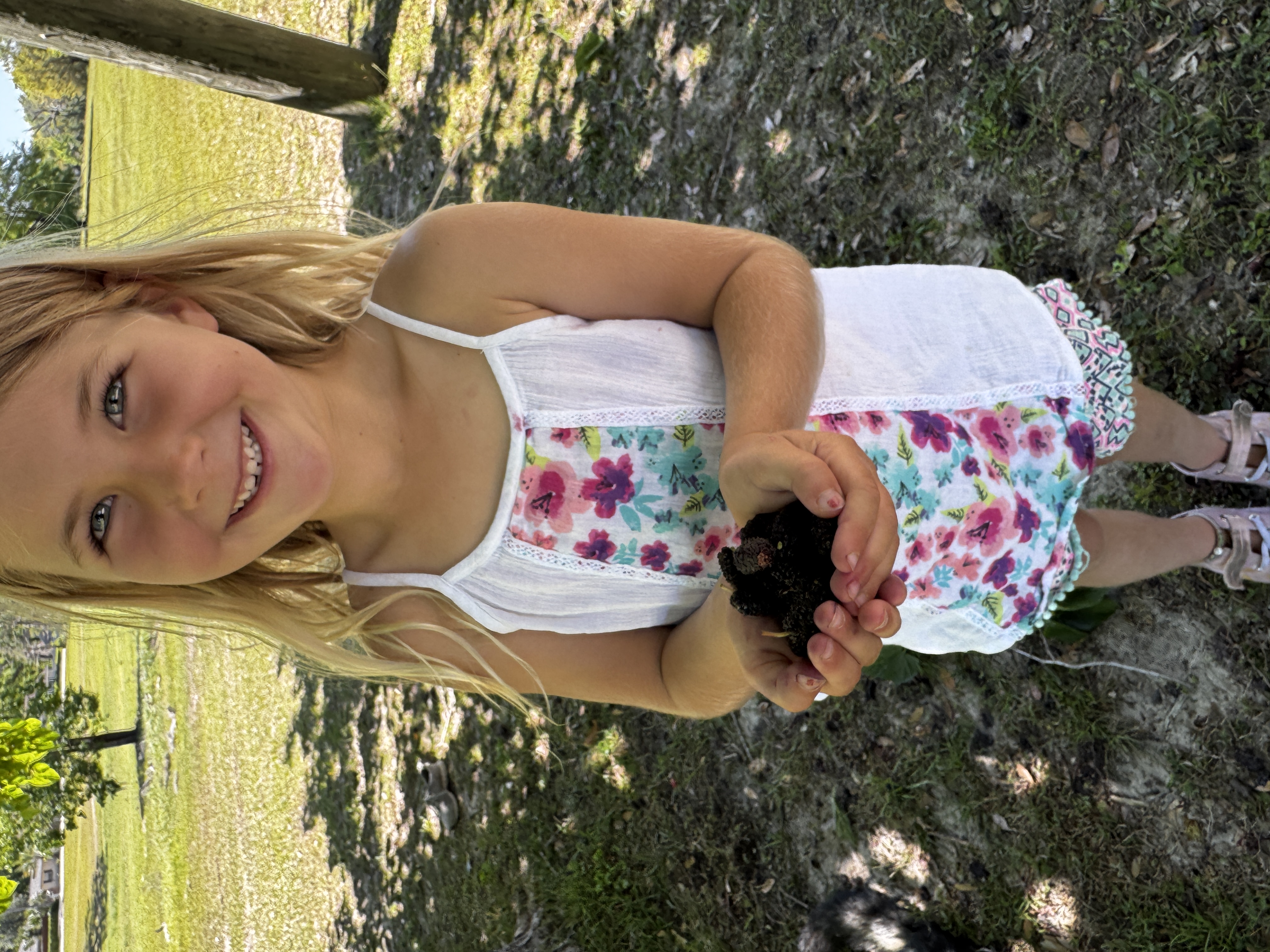
We learned the most when Ceanna’s curiosity led the way. If she earned or received money, we’d count it together. We sorted and grouped pinecones, wrote birthday cards, crafted, learned to make kombucha and other potions, and baked banana bread side by side. Learning unfolded naturally in our everyday moments. We personified our neighborhood mulberry tree, witnessing her changes across the seasons, and used our imagination to dream what she may wonder about. At first, I thought I’d carefully document all this magic—but that didn’t happen, and that’s perfectly okay.
We picked up some structured curriculum funded by the state scholarship we receive, which we used when interest aligned. I often would suggest them as an option when she came to me with that dreadful statement “I’m bored”, my response: “let’s do some school books”. Sometimes she said okay, sometimes she said no. I lovingly welcomed either response. Bonus, over time, I now hear that “I’m bored” statement less and less.
I love this quote by Ginny Yurich on boredom in her book, Homeschooling: “boredom is not failure. Boredom is a springboard. It is a catalyst. It is gold. It is where the good stuff comes from. It is exciting. It represents endless possibilities. Boredom is a gift we hand to our children. It is the foundation of delight and discovery. Boredom is where we fall in love with painting, with music, with lying in the grass and watching the clouds float by, with life.”
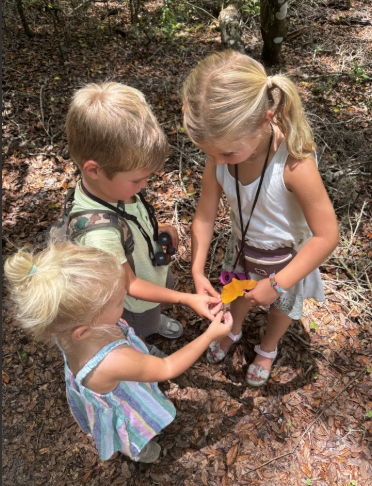
One question almost every homeschooling family gets is ‘what about socialization?’ We spend at a minimum one full day, typically 2-3 days a week, surrounded by other homeschool families, typically playing somewhere outside. As I outlined in this post, these outings provide time for our kids to play and explore in community, while us moms also enjoy each other’s fellowship. We make this a priority, because to quote Dr. Carla Hannaford, “the most important activity we can engage in to increase brain integration is unstructured, imaginative play.” Our community also engaged in my formal learning together, studying topics like outer space and early American history, plus went on my field trips together touring places like local farms.
One year in, and one may ask, how is all of this working out? Well based on my own measures of Ceanna’s emotional intelligence, all of our mental well-being thriving in our home – I give us an A+. Alas, I have yet to find an official system or governing body that values these as markers of success.
I hesitate to include this, but I can’t ignore the relevance here. While the State of Florida does not require homeschool families to take tests, the State organized Personalize Education Program we’re enrolled in to receive scholarship funds does require a once a year nationally normed test. There is no minimum score or expectation – just the submission of reading and math results. I could have negative opinions about this, and maybe at first, I did. But I choose to believe they require this to demonstrate learning and growth and justify continued support for the scholarship in the budget.
We found an online, proctored test she could take from the comfort of home. I didn’t do any prep with her beforehand. Big brother watched baby, we popped some popcorn (because who doesn’t want something to chew on while testing), turned on deep focus music, and tackled the test one question at a time. I read the questions aloud, and Ceanna answered—some she knew, many she guessed. We took wiggle and laugh breaks. And we powered through. Even when I knew she knew the right answer but chose incorrectly, I resisted the urge to step in.
I was fully prepared for the results to show she was behind. I had already made peace with that, knowing in my heart she’s growing and learning in her own time. So, imagine my genuine surprise and joy to receive results showing she’s above grade level! Joyous as I was, it made me wonder - how could this be? We spent so little time on formal reading and math. It almost felt unfair to the kids who’ve spent countless hours drilling and studying.
Well it turns out, we’re always learning. Our children can learn by following their heart and interests. And in the margins of living life, the ‘important’ things seep through.
Will she be reading independently anytime soon? I suppose that depends if the right book comes along that she just has to read on her own. We’ll march on into ‘first grade’ low pressure and following her lead – spending lots of time playing, laughing, dancing, and soaking in nature.
My hope in sharing our story is that it may inspire us all to look at education differently, with curiosity and bravery. If you are reading this as someone considering homeschooling and unsure if you can do it, let this be your beacon that it may not need to be as complicated as you'd think. If you are reading this and a different schooling method is what works for your family (a I appreciate that you still choose to read this all the way through) and maybe there is a glimmer of hope that you don't have to take your child's formal schooling as seriously and can infuse a bit more freedom and play into the margins of your child's life. May we all be a bit more flexible and expansive as we navigate our evolving world and help shape tomorrow's leaders.
I’ll end with this quote by John Holt, from his book, Learning All the Time: “Children learn from anything and everything they see. They learn wherever they are, not just in special learning places.”
P.S. If you’re a homeschooling mama in Lake County, Florida, looking for a like-hearted community to grow and play alongside with your kiddos, I’d love to connect. Reach out to me at courtashworth@outlook.com—because I truly believe we’re not meant to do this alone.